

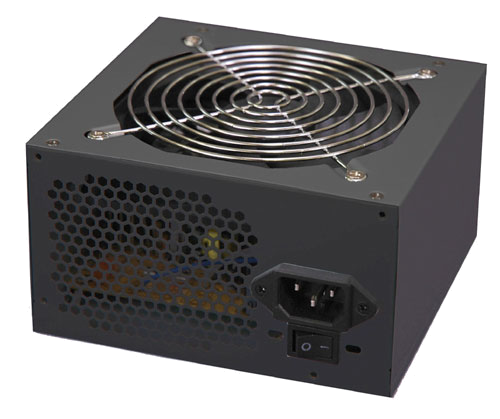
Following on from the slight surprise that a new PSU is a poor investment for a low power PC I decided I’d reassure myself that an efficient PSU is a good investment for a typical “enthusiast” PC.
To do this depends on the configuration, how much time the PC spends on, and how much time it spends being heavily utilised. I’m basing this on a fairly-high power single-GPU system with a Core i7 CPU and a Radeon 5870. I’m also going to assume the system is operated from 3pm — 11pm weekdays and 9am — 1am weekends, making for a total of 72 hours a week. I’ll also assume the system spends 50% time idle and 50% full-load.
The system in question pulls ~80w idle and ~340w under full load. Finding efficiencies for this is tricky, so the value will be rounded up to 400w (the PSU’s in question don’t vary greatly between 300w and 400w)
All of these estimates are deliberately on the high side. I expect a typical PC will spend more time off, more time idle, and wont be loaded as intensely as the example. Most systems also use lower power CPU’s and GPU’s too.
The figure for the generic PSU is based on the minimum requirement and is therefore a worst case. Even with a very poor efficiency PSU the AC draw from the wall won’t increase as the DC draw decreases. I have calculated a best-case yearly saving, based on a kWh charge of 10p.
| Make / Model | Efficiency at idle (80W) | Efficiency at load (340W) | Est. A.C. power draw at idle | Est. A.C. power draw at load | Saving |
| ATX v2.2 400w | 65% (at 80w) | 70% (at 400w) | 123W | 486W | |
| Seasonic X‑400 | 85.4% (at 90.4w) | 89.9% (at 400w) | 94W | 378W | £25.63 |
| Corsair AX850 | 83.5% (at 90w) | 89% (at 400w) | 96W | 382W | £24.52 |
| Enermax Modu87+ 500w | 85.9% (at 88.5w) | 87.6% (at 400w) | 93W | 388W | £23.87 |
| Corsair CX400W | 81.2% (at 90.2w) | 81.5% (at 400w) | 99W | 417W | £17.43 |
| Kingwin Lazer Platinum 550W | 92.1% (at 91.2w) | 92.9% (at 400w) | 87W | 366W | £29.19 |
| HuntKey Jumper R90 300W 80+ Gold | 88% (at 60w) | 86% (at 330w) | 87W | 366W | £23.17 |
A new PSU in this scenario is probably not advisable on a financial only basis. Even with quite a lot of heavy use, and comparing the most efficient PSU’s with the worst a budget ATX PSU can perform the saving will take around 5 years to recoup. A real world upgrade is unlikely to net this much saving.
If you are considering replacing an existing PSU my advice would be not to bother, unless you have additional reasons. If you are buying new then it is worth paying more for a better PSU, within reason. Of course if you want the efficiency for other reasons (low noise, low heat) then those factors may make the value difference irrelevant.
Update (25-Dec-2011)
Added the HuntKey Jumper R90. Whilst it is sold as a 300W PSU, it does work slightly above spec, especially if well cooled. This PSU does make a bit of different to the conclusions. It produces savings of over £20, which is a significant proportion of the price of the PSU! A payback period of 2 year, with an expectation that electricity prices will continue to rise would certainly be worth thinking about. However, the HuntKey isn’t specified high enough to really provide for the configuration specified in this scenario, and as such we couldn’t recommend running it beyond its rating.





“Hi James I realise it has been a long while, but I just checked this on windows 11 (build 23H2)…”